In the world of numismatics, the late 1940s are often viewed as a period of high-volume normalcy. As we navigate the 2026 coin market, the 1948 Wheat Penny is a fascinating case study in how rarity is redefined by modern grading standards and auction fever. Only a handful of survivors' items command the attention of elite investors at major auction houses. The 1948 wheat penny value is not a unique date in the traditional sense; with a combined mintage of over 500 million coins across three mints, it is a common sight in circulated collections. Yet, in the high-stakes arena of actual auctions, common is a relative term. The paradox lies in the condition of rarity. While millions of 1948 pennies exist in Brown or Very Fine condition, to find one that has retained its original fiery red luster and remained mark-free for nearly 80 years is a monumental challenge. The difference between an ordinary 10-cent and a $3,000 auction lot comes down to a single point on the grading scale. In today's market, a 1948 penny graded MS-66 is accessible, but an MS-67+ Red is a gem coin that triggers bidding wars. Two positions on the market are always valued at higher prices. Denver Red issue and Philadelphia sets. The Denver Mint D is known for producing relatively sharp strikes in 1948, yet "plus" grades. They denote a coin that is at the very top of its assigned grade and is exceptionally rare. For a 1948 penny to reach this club, Red status is mandatory. A Red-Brown coin of the same technical grade might only fetch 20 % of the price of its fully red counterpart. The Philadelphia strike no mint mark, often suffers from mushy details because of the overused dies. This makes a crisp, MS-67 piece highly coveted for Registry Sets are digital portfolios where collectors compete for the highest-ranked collection. For the actual value, use the coin value checker free. Auction results from early years show that MS-67 Philadelphia cents are currently holding steady between $800 and $1,200. Die Cracks – look for Die Cracks across the scalp or cracks through the wheat stalks on the reverse. Cuds – is a major die break that involves the rim of the coin, leaving a raised, featureless blob of metal on the surface. A large 1948 Cud is rarer than a simple die crack. The San Francisco mint (S) produced one of the most famous varieties of the year: the DDO-001. Look for distinct doubling on the word "LIBERTY" and the "4" and "8" of the date. While a raw (unauthenticated) DDO might sell for $50 on eBay, a certified MS-65 Red issue can easily fetch $500+ at auction. The market for authenticated errors is currently outpacing the market for standard coins. RPMs occur when the mint mark was punched into the die twice. RPM S over S – in Gem BU condition, these are performing well, often selling for $50 to $100, a massive leap from the coin's $0.01 face value. The shift from a common penny to an RPM variety is the ultimate treasure hunt for 2026 collectors using digital microscopes to scan their wheat heaps. Errors such as Clipped Planchets or Retained Laminations have seen a 15 % value increase in today’s market. A major 1948 lamination crack can sell for $40–$70 on platforms like eBay. The value gap is staggering: Type Value Grade Abbreviation Brown $5–$10 MS-65 BN Red-Brown $25–$40 MS-65 RB Red $150+ MS-65 RD A coin that is turning from Red to Red-Brown in its holder can lose half its auction value in a single season. Nowadays, collectors prioritize coins with stable luster. The CAC (Certified Acceptance Corporation) sticker is a small green bean-shaped label added to a slab. The sticker verifies that the grade is solid for the category. In 2026 auctions, a 1948 penny with a CAC sticker often realizes a 30-50 % bonus over a non-stickered coin of the same grade. Heritage Auctions – for MS-67+ and record-breaking varieties. GreatCollections – the primary battlefield for certified MS65 and MS66 Red cents. eBay – the wild west of raw errors. Many collectors buy uncertified 1948 pennies here, hoping to DDO or over-defect and get it graded for a massive profit. Philadelphia – $10,350 – 2012 Denver – $3,600 – 2025 Denver – $3,000 – 2022 Denver – $1,020 – 2022 San Francisco – $1,020 – 2022 Denver – $480 – 2023 San Francisco – $456 – 2023 All auction records in the list are for the MS-67 Red and from Heritage Auctions. Check the results with the coin checker. First of all, you need to measure basic item specifications, such as weight or diameter. Weight 3.11 grams Diameter 19.05 mm Edge Plain The second step is to identify the color grading factor. The third step is to identify rare varieties and defects. The fourth step is certification. Standard 1948 pennies are not made of silver. In fact, a genuine 1948 U.S. Lincoln Wheat Penny is essentially the opposite of a silver coin in terms of its metal content. Here is the breakdown of why you might see a silvery 1948 penny and what the coin is actually made of: 95 % Copper 5 % Tin and Zinc Reddish-Orange Color If you have a 1948 penny that appears silver or chrome in color, it is almost certainly due to one of the following non-silver reasons: Plating – it was common for people (or high school chemistry students) to plate pennies in zinc, chrome, or mercury as a science experiment or for use in jewelry. Environmental Damage – exposure to certain chemicals can strip the outer copper look or leave a greyish residue.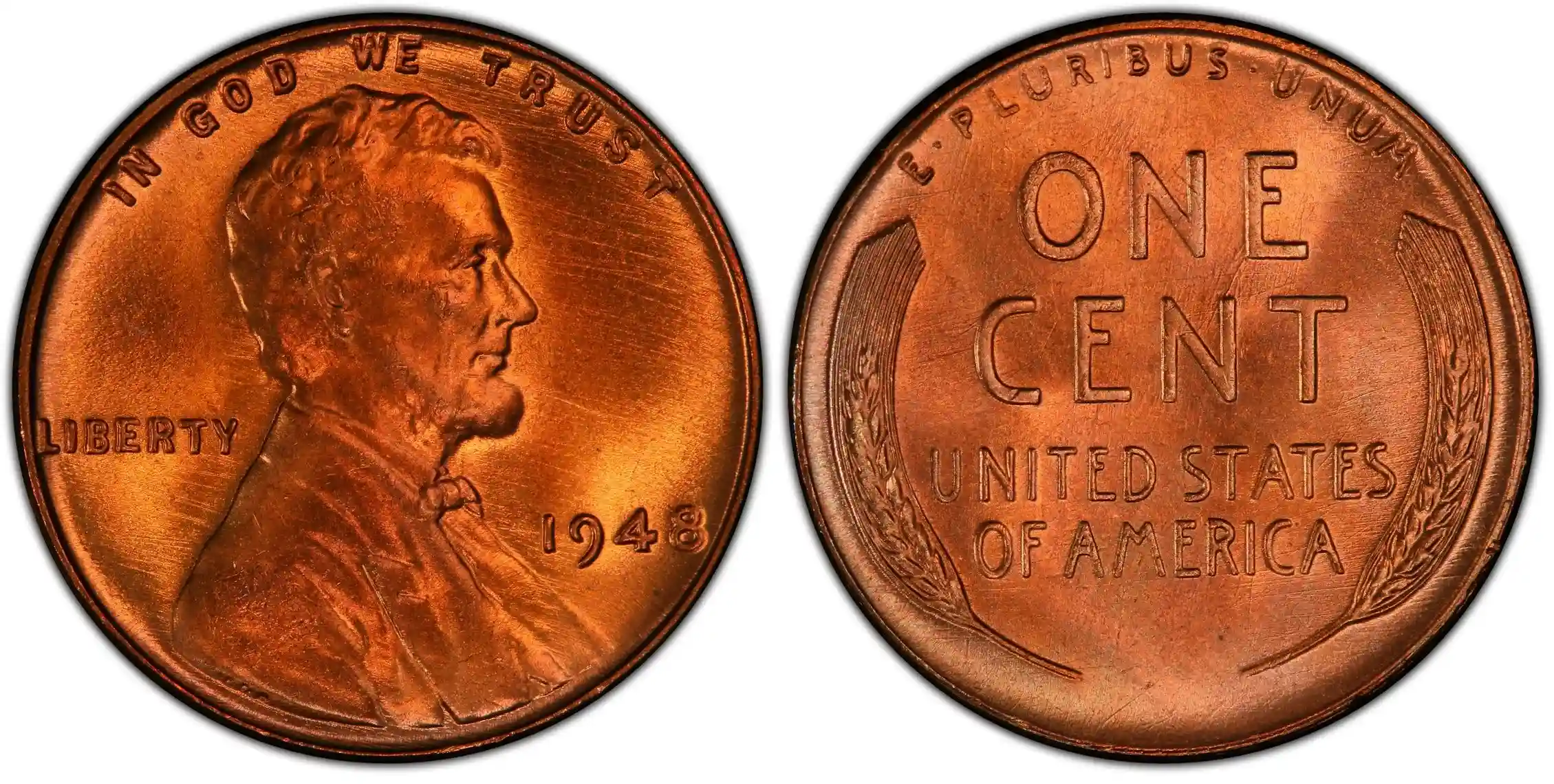
The Item Paradox
The Four-Figure Divide
The Top Auction Records
The 1948-D MS-67+ Red
1948 Philadelphia Sets
Rarest Error Varieties
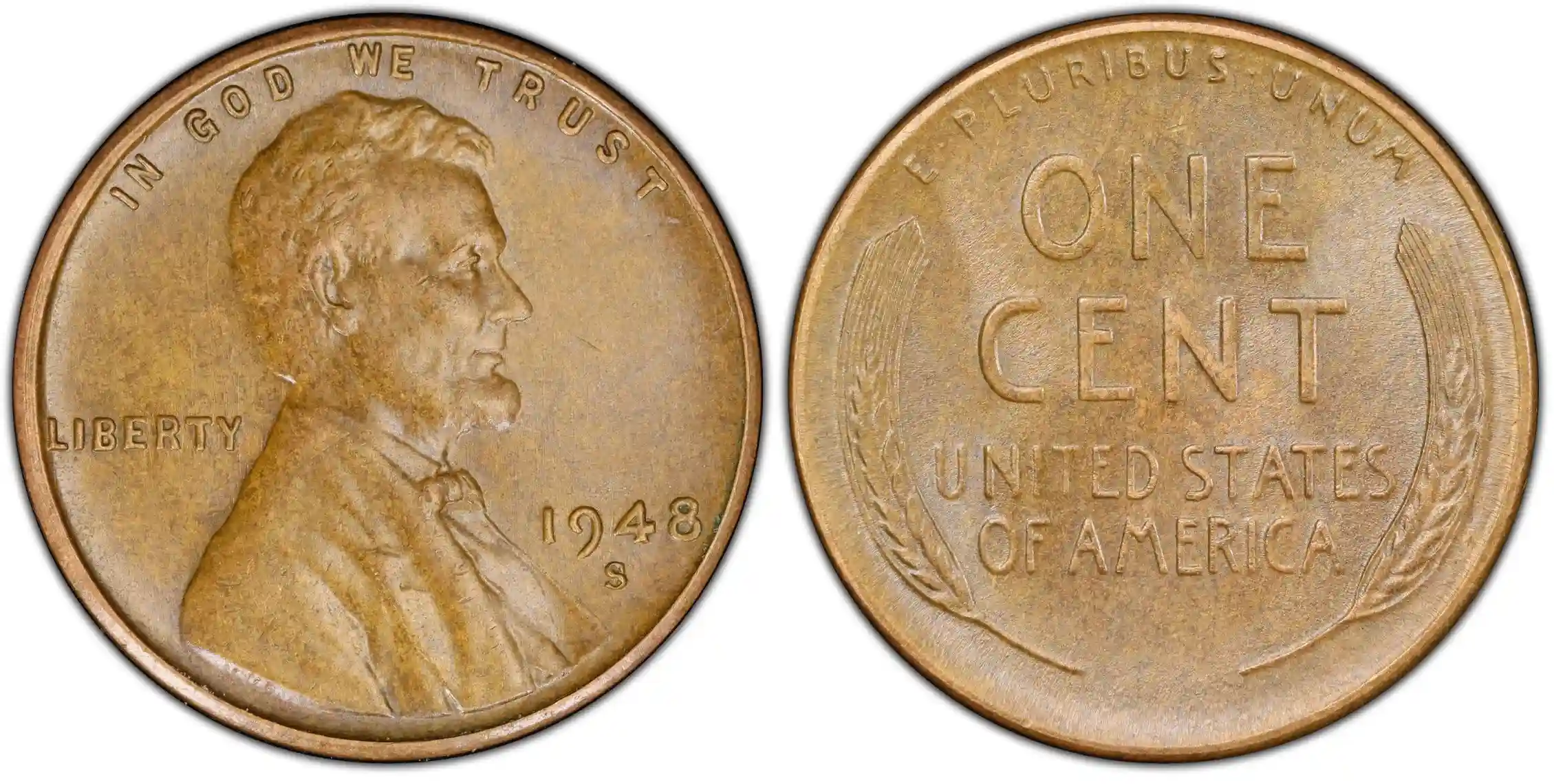
S DDO-001 – The Doubled Die Obverse
Re-punched Mint Marks
Lamination Cracks and Planchet Errors
Grading Secrets That Trigger Auction Bidding Wars
The Role of the CAC Sticker
2026 Top Marketplaces
Auction Records List
How to Identify a Rare Item?
Is a 1948 Penny Made of Silver?
Why Does My 1948 Penny Look Silver?
Learn more
